メタンおよびその他C1ガスの放射性炭素分析と安定同位体分析
メタン (14C) の放射性炭素 (δ13C) および安定炭素同位体 (CH4) 分析は、さまざまな生態系におけるメタンの起源、動態、循環を解明するための有用な情報を提供します。
CH4 の同位体分析により、以下の知見が得られます:
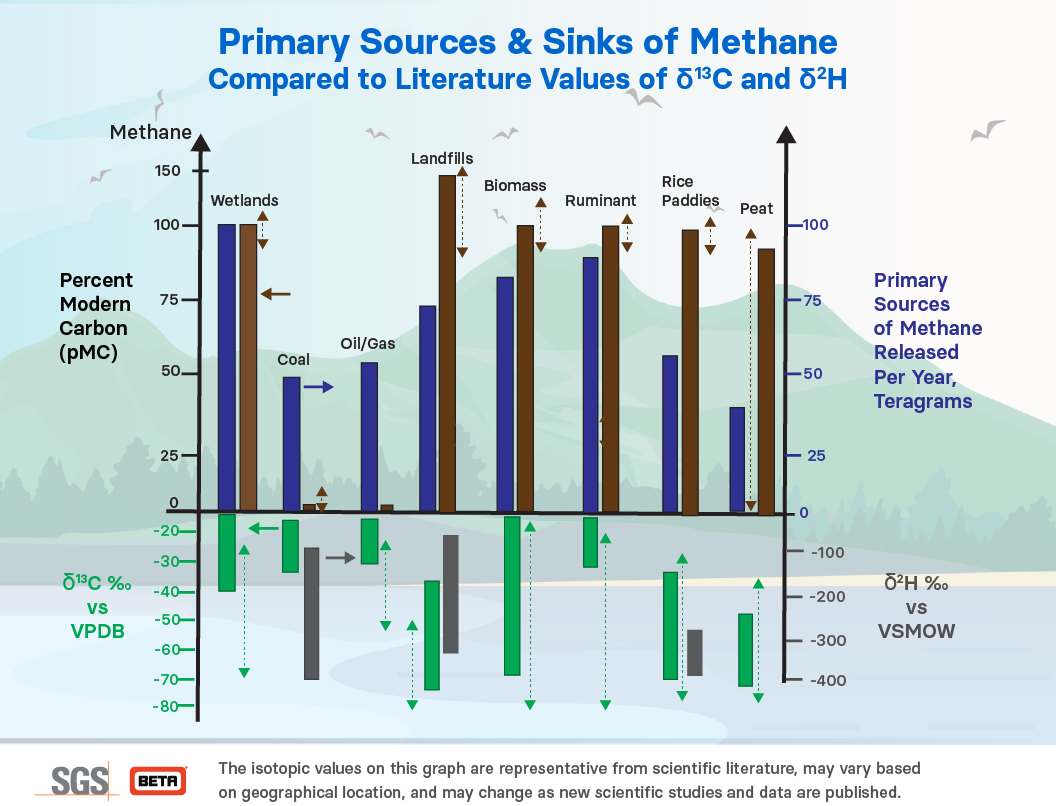
 このグラフの同位体データは科学文献の代表的な値であり、地理的な条件によって異なる場合があります。また、新しい研究やデータの発表により、変更される可能性があります。
- メタン生成(非生物的要因 vs 生物的要因)
- 地質構造(炭層、トラップガスなど)
- 氷河メタンガス(メタンハイドレート)
- オープン vs クローズド カーボン メタン生成システム(混合)
- メタン ソース トラッキング(埋立地 vs 湿地 vs パイプライン)
- 土壌ガス(生態系モニタリング)
- 生態系クレジットの割り当て(炭素フラックスモニタリング)
- 経時変化(メタン生成システム変化)
- 形成後の反応(酸化効果)
- バイオガス発生の最適化(原料分析、製品ガス分析)
メタンは天然に存在する炭化水素ガスで、さまざまな環境で起こる複雑な生物地球化学反応によって生成されます。メタンおよび随伴ガスの放射性炭素および安定同位体分析により、上記で概説したようなさまざまな状況におけるメタンについて調査することが可能となります
SGS Betaのガス分析サービス-Carbon-14& Carbon-13
SGS Betaは現在、純粋なメタンだけでなく、メタン濃度が2 % ( v/v) 以上(試料量0.6Lの場合)の混合ガスサンプルの放射性炭素 (14C) および安定同位体 (δ13C) の測定が可能です。 SGS Betaが分析できるサンプルの種類については、以下のリストを参照してください。
- バルクガス(全炭素)
- C1ガス混合(CH4, CO2, CO)
- 分離されたCH4
- 分離したCO2(随伴ガス)
- 分離されたCO
試料は同位体分析の前にASTM D7833を用いてガス組成の事前スクリーニングを行います。ガスクロマトグラフィーのレポートは、ご要望に応じて提供可能です。
サンプルを提出する準備はできましたか?
お近くの担当者またはUS.Info.Beta@sgs.comにご連絡いただき、”炭化水素ガスの14C年代測定に関する質問フォーム”を入手してください。 サンプルをお送りいただく前に、「質問フォーム」をご提出いただき、弊社ラボチームによる承認が必要であることにご留意ください。
ガイドライン全文は、こちらをご覧ください.
ご質問や詳細については、US.Info.Beta@sgs.comまでお問い合わせください。
よろしければこちらもご覧ください
化石由来 vs バイオジェニックガス試験
参考文献:
- Aelion, C. M., Höhener, P., Hunkeler, D., & Aravena, R. (2009). Environmental isotopes in biodegradation and bioremediation. CRC press.
- Garnett, M. H., Hardie, S. M. L., Murray, C., & Billett, M. F. (2013). Radiocarbon dating of methane and carbon dioxide evaded from a temperate peatland stream. Biogeochemistry, 114, 213-223.
- Garnett, M. H., Hardie, S. M., & Murray, C. (2020). Radiocarbon analysis reveals that vegetation facilitates the release of old methane in a temperate raised bog. Biogeochemistry, 148(1), 1-17.
- Bezyk, Y., Górka, M., Kruszewski, Ł., Nęcki, J., Sówka, I., Jońca, J., … & Widory, D. (2024). Detecting and sourcing GHGs and atmospheric trace gases in a municipal waste treatment plant using coupled chemistry and isotope compositions. Waste management (New York, NY), 190, 382-397.
- Kerfoot, H. B., Hagedorn, B., & Verwiel, M. (2013). Evaluation of the age of landfill gas methane in landfill gas–natural gas mixtures using co-occurring constituents. Environmental Science: Processes & Impacts, 15(6), 1153-1161.
- Hackley, K. C., Liu, C. L., & Coleman, D. D. (1996). Environmental isotope characteristics of landfill leachates and gases. Groundwater, 34(5), 827-836.
- Coleman, D. D., Liu, C. L., Hackley, K. C., & Pelphrey, S. R. (1995). Isotopic identification of landfill methane. Environmental Geosciences, 2(2), 95-103.
- de la Fuente, M. D. M., Narros, A., Sánchez, C., & Rodríguez, E. (2024). Quantification of methane oxidation measuring isotopic signal in 13C on Spanish landfills. Atmospheric Pollution Research, 15(9), 102198
- Petrenko, V. V., Smith, A. M., Brailsford, G., Riedel, K., Hua, Q., Lowe, D., … & Brook, E. J. (2008). A new method for analyzing 14C of methane in ancient air extracted from glacial ice. Radiocarbon, 50(1), 53-73.
- MOYA/ZWAMPS Team, Nisbet, E. G., Allen, G., Fisher, R. E., France, J. L., Lee, J. D., … & E. Wilde, S. (2022). Isotopic signatures of methane emissions from tropical fires, agriculture and wetlands: the MOYA and ZWAMPS flights. Philosophical Transactions of the Royal Society A, 380(2215), 20210112
- Hodson, A. J., Nowak, A., Hornum, M. T., Senger, K., Redeker, K., Christiansen, H. H., … & Marca, A. (2020). Sub-permafrost methane seepage from open-system pingos in Svalbard. The Cryosphere, 14(11), 3829-3842.
最終更新日:2026年8月