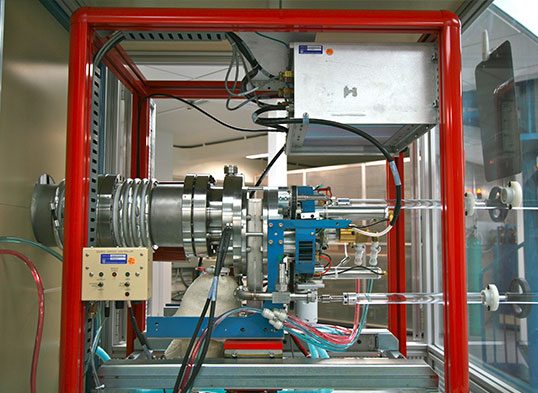
Radiometric
and AMS graphitization laboratories are located in a building specifically designed for
efficient radiocarbon dating analyses. The Radiometric division presently has 26
chemical synthesis lines and more than 65 state of the art Liquid Scintillation Counters.
Beta Analytic employs the benzene method of analysis, which was in part pioneered by Dr.
Tamers. The AMS division presently has 63 chemical combustion and
graphitization lines, which supply Beta Analytic's Accelerator Consortium with sample
graphite. The capability of large volume analysis in both the radiometric and AMS
divisions was through the design of Mr. Hood. Both techniques have a practical dating
range of a few hundred years to as much as 45,000 years B.R (before present, 1950 A.D.).
Conventional Radiometric Technique
Standard Service* is for samples containing at least 1.0 to 4.0 grams of final
carbon (carbon remaining after all necessary pretreatments and chemical syntheses have
been performed). Typical quantities needed for sample types: Sending Samples & Quantities
Complex/Non-Standard Services* are for samples containing 0.3 to 1.0 grams of final carbon
or those which require extensive specialized handling, such as organic sediments weighing
more than 200 grams on arrival and bones.
Quoted precision (the
"+/- value" reported with the age of the sample) for optimal size samples
generally ranges from 40-80 years for samples less than 10,000 years old. Less than
optimal size samples will produce larger than normal associated standard deviations that
will vary with sample size and antiquity.
In many cases precision may be enhanced by
using the Extended Counting Service*. This service may be authorized for less than
recommended or minimal size samples at any time or for any sample where enhanced precision
is required.
Accelerator Mass Spectrometry (AMS)
Accuracy and precision is similar to Radiometric analysis. However,
much less material is necessary for the analysis. The AMS technique is uniquely suited for
very small samples containing 0.00025 to 0.3 grams of final carbon.
Typical quantities needed for sample types: Sending Samples & Quantities
Quoted precision generally ranges from 0.5 to 3 percent of the sample age and is
independent of sample size. Precision will be better than Radiometric analysis for samples
more than 10,000 years old.
International Consortium of AMS Laboratories
Routine AMS measurements have been performed since 1983 when Beta Analytic formed
a consortium with one of the oldest and most prestigious accelerator laboratories in the
world, ETH (Eidgenossiche Technische Hochschule) in Switzerland. Over the
years, many accelerator facilities have requested membership in this International
Consortium of AMS Laboratories. To date, we have selected six of the premier accelerator
facilities as members to this consortium and have carefully intercalibrated each, to both
international and in-house dating standards. This assures that all AMS dates reported from
the consortium will be in agreement with the now more than 85,000 radiometric dates
reported by Beta's Conventional Radiometric laboratory. All chemical treatments and target
preparations are performed at Beta Analytic in our AMS graphitization laboratory. The
samples are then sent by express courier to one of our Consortium Laboratories where the
samples are measured and the results returned via computer link to Beta Analytic for final
calculation, cross-checks and reporting.
Stable
Isotope Ratios (C13/12)
Measurement of the 13C/12C ratio allows for correction of the measured 14C age
based on the amount of isotopic fractionation (enrichment or depletion) in the individual
sample as compared to the modern standard. If best accuracy is needed, this ratio should
be requested along with the radiocarbon dating. If the measurement is not made, one is
assumed in the age calculation. For identified materials, this estimate can be very close
to the measured value. However, it is especially important for unidentified plant
materials which may contain a mixture of C3 (e.g. typical hardwood trees) and C4
(e.g. corn) pathway plants, and CAMS pathway plants (e.g. yucca),
which could result in a 250 year error in accuracy without the measurement. It is
important for bones since it will give insight into the purity of the protein extracted
for analysis.
Sample
Quantities Required for Analyses
It is important to remember that the "General Sample Size
Requirements" are estimates. Normal pretreatment procedures can remove 30
to 70 percent of the original material sent. Water, adhering mineral matter and
carbon losses from essential chemical pretreatment are basic factors to consider and to
allow for when determining the amount of material required. As an example, typically only
25% of the weight of a submitted, clean charcoal sample is available for analysis (1 gram
final carbon from 4 grams submitted charcoal). Typical quantities needed
for sample types: Sending Samples & Quantities
Quality Assurance
Beta Analytic is unequalled in its commitment to the
quality of the results reported to our clients and colleagues. Our "Experience
Factor", with over 120,000 dates reported on samples of all types from
around the world, cannot be duplicated. All accepted international conventions for
radiocarbon dating are carefully followed The modern reference used is the NBS Oxalic Acid
Carbon-14 Standard. Extensive routine inter-calibrations between the Radiometric and
Consortium Accelerator Laboratories as well as participation in ongoing International
Radiocarbon lntercalibrations such as IAEA (International Atomic Energy
Agency) and TIRI (Third International Radiocarbon Intercalibrations) assures
reliable results. Daily monitoring of instrumentation and chemical purity is performed in
addition to extensive computer cross checks of statistical analyses and final age
calculations. (*Results of international Radiocarbon Intercalibrations and QA/QC documents
are available upon request.)
Potential Anomalous Results
Experimentation
has determined that the rate of production of radiocarbon in the earth's atmosphere is not
constant. This is due to variations in the heliomagnetic modulation of the
galactic cosmic radiation. Differences of several percent have been observed in
the radiocarbon concentrations of contemporary plants. Dating errors, independent
of statistics or laboratory procedures, caused by these variations in the sun's
magnetic field, can be as much as several hundred of years. It is
generally considered that four radiocarbon dates on a specific feature is sufficient to
identify the occurrence of this error.
Report of Analyses
Upon receipt of samples at the laboratory,
an acknowledgement is sent notifying you of the sample's safe arrival. The acknowledgement
will also inform you of the date by which your results will be reported. When the analyses
have been completed, you will receive by first class mail a written report (reports are
also sent by E-mail or FAX) that details the results of the material analyzed.
Additionally, where applicable, you will receive a publication quality print-out of the
Calibration of Radiocarbon Age to Calendar Years (dendro-calibration) for each
sample.
Note:
Please be sure to indicate the geographic location of any sample. Additionally, if the
sample is shell or carbonate, please indicate if the origin is marine or freshwater. This
information is essential in determining the necessary reservoir corrections (D R values), that will be used in the final calculations for the
Calibration of Radiocarbon Age to Calendar Years.
See: Analytical Procedures and Final Report |