These are five examples of how δ13C, δ²H and 14C analyses are applied in real-world environmental monitoring.
The δ¹³C analysis of CH₄ and CO₂ from soil gas and landfills has become an essential tool for distinguishing between biogenic and geogenic carbon sources. Methane in soils may originate from microbial methanogenesis, thermogenic migration of gas, or even abiotic reactions. Each of these processes undergo 13/12C isotopic fractionation to produce a δ¹³C signature. Microbial pathways have shown in the scientific literature ¹³C-depleted values of methane from –50 to –110‰, thermogenic gas is moderately depleted (–30 to –50‰), while abiotic or mantle-derived methane can be comparatively enriched (–5 to –30‰). By measuring δ¹³C alongside depth profiles, methane sourcing can be inferred by actively forming in situ under anaerobic conditions or migrated fossil gas contaminating shallow soil layers. δ¹³C enrichment of the CO2 fraction from landfill gas has also been observed from –10 to +15‰. The δ¹³C of the CO₂ fraction provides complementary insight into carbon cycling and potential contamination when compared to the CH4 fraction. Soil-respired CO₂ from vegetation is typically more negative in C₃ ecosystems (–22 to –37‰) and less depleted in C₄ systems (–9 to –15‰). Deviations from these ranges such as enrichment toward 0‰ may indicate carbonate dissolution or thermogenic degassing rather than root or microbial respiration.
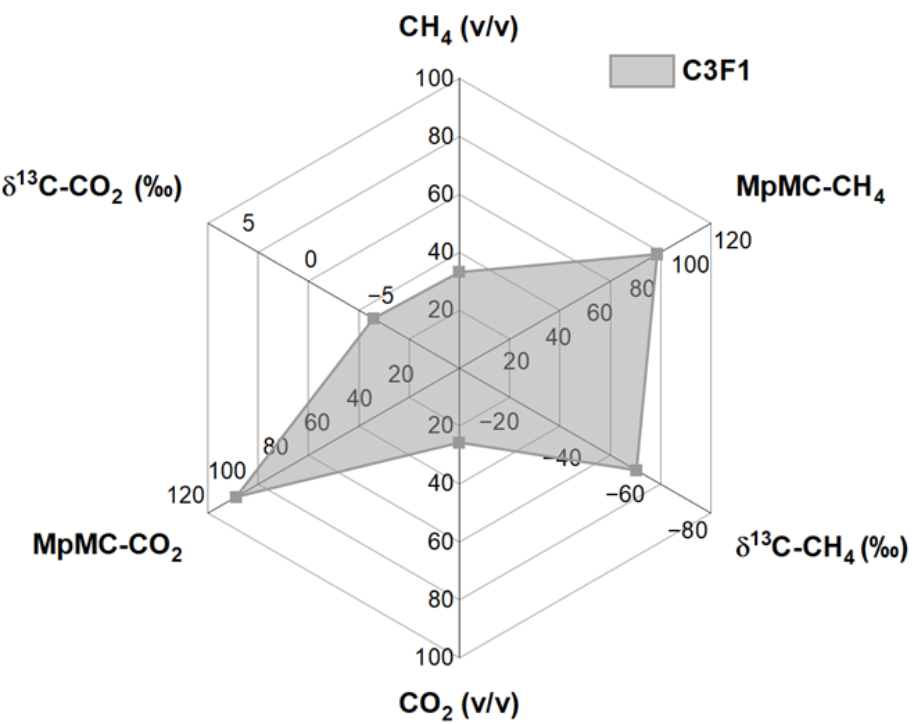
Figure 1: Class III Flare 1 landfill analyses of six parameters measured at SGS Beta (R&D Department) include: (a) CH4 concentration of the bulk gas as % (v/v), top; (b) the Measured pMC (MpMC) of the CH4 isolated from the bulk gas, top right; (c) the δ13C of the CH4 isolated from the bulk gas, bottom right; (d) CO2 concentration of the bulk gas as % (v/v), bottom; (e) the Measured pMC (MpMC) of the CO2 isolated from the bulk gas, bottom left; and (f) the δ13C of the CO2 isolated from the bulk gas, top left.
δ²H analysis provides a standalone tool for investigating the origin and formation of hydrocarbon gases by measuring the hydrogen isotope composition of methane (CH₄), ethane (C₂H₆), and propane (C₃H₈). Hydrogen isotope ratios are influenced by the source of hydrogen, formation pathway, environmental conditions, and the thermal history of the gas in thermogenic systems.
For methane, δ²H can help investigate microbial methanogenesis and distinguish between different methane formation pathways. Microbial methane inherits hydrogen from environmental water and substrates, with isotope fractionation occurring during methanogenesis. For ethane and propane, δ²H provides additional information on thermogenic hydrocarbon systems. Hydrogen isotope compositions can vary with thermal maturity, depositional environment, gas generation, and secondary processes. Comparing δ²H across methane, ethane, and propane can therefore help evaluate relationships among gases, identify potential mixing or migration, and support petroleum-system and source interpretation.
Analysis of δ¹³C and δ²H provide complementary information about the origin and formation pathways of hydrocarbon gases. When interpreted together, the carbon and hydrogen isotope compositions of methane can strengthen differentiation among microbial, thermogenic, and abiotic sources compared with concentration data or either isotope system alone.
Cross-plotting δ¹³C-CH₄ and δ²H-CH₄ is commonly used to evaluate methane source, fate, and formation pathways. Microbial methane may reflect different methanogenic pathways and environmental conditions, while thermogenic methane is generated through the thermal breakdown of deeply buried organic matter. Although isotopic source fields can overlap, combined δ¹³C and δ²H measurements provide an additional line of evidence for source attribution when interpreted alongside gas composition, site conditions, and other available data.
Compound-specific δ¹³C and δ²H analysis of ethane (C₂H₆) and propane (C₃H₈) provides additional information for interpreting hydrocarbon gas origin alongside methane. Because higher-chain hydrocarbons are generally associated with thermogenic and some abiotic gas systems rather than microbial methanogenesis, their abundance and isotopic composition can help constrain source attribution, gas mixing, migration, and thermal history.
By analyzing methane, ethane, and propane using both carbon and hydrogen isotope systems, SGS Beta provides a multi-compound isotopic fingerprint for hydrocarbon gas source attribution, environmental monitoring, and petroleum system studies.
Stable isotopes δ¹³C and δ²H provide complementary information about hydrocarbon gas source and formation pathways, while ¹⁴C provides an additional constraint on the origin and age of the carbon source. Combining these isotope systems creates a powerful framework for understanding carbon cycling in methane producing ecosystems such as blue carbon and peatlands. 14C of product gases can also provide interpretation of fossil versus biogenic carbon feedstocks and facilitate optimizing and understanding biogas formation when mixed carbon feedstocks are present.
For information on SGS Beta’s services for hydrocarbon gases, including sample submission guidelines, please visit – https://www.radiocarbon.com/hydrocarbon-isotope-analysis.htm
You may also contact the laboratory at US.info.beta@sgs.com or (+1) 305-667-5167.
Page last updated: October 2026
This entry was posted on Saturday, October 31st, 2026 and is filed under SGS Beta Updates .
