Join our FREE webinar: Integrating Radiocarbon and Isotope Analysis in Quaternary Research
September 17, 2026 (11 AM EST)
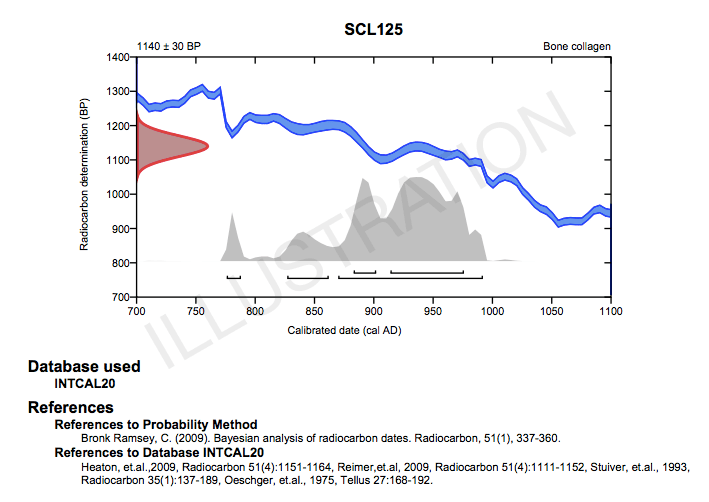
Calibrations of radiocarbon age determinations are applied to convert the Conventional Radiocarbon Age (BP age corrected for isotopic fractionation using a δ13C value) to calendar years.
The parameters used for the corrections have been obtained through precise radiocarbon dating of thousands of samples taken from known-age tree rings of oak, sequoia, and fir up to about 13,900 BP. Beyond that, back to about 55,000 BP, correlation is made using multiple lines of evidence. This information is compiled into internationally accepted databases which are updated on occasion. The present databases are IntCal20 (northern hemisphere), SHCal20 (southern hemisphere) and Marine20 (marine environments).
It has become common practice in recent years for researchers to use a mathematical method called the “High-Probability Density Range Method” or HPD for the calibration of the Conventional Radiocarbon Age to calendar year equivalents. The HPD method assigns relative likelihoods to the calibrated range or ranges generated. These are listed as percent values of the relative likelihood of one calibrated range to another at the 95.4% (2-sigma) and 68.2% (1-sigma) probability levels.
The higher the percentage, the more likely the range represents the true age range. The percentages in each probability level total 95.4% or 68.2% and are relative to each other for that specific probability level. In most cases, only the 95.4% probability ranges should be considered when comparing radiocarbon ages.
Calibration of marine carbonate samples requires correction for both global and local geographic reservoir effects. Reservoir corrections for freshwater carbonates (typically termed “hard water effect”) are usually unknown and are generally not easily accounted for in calendar calibrations.
Disclaimer: This video is hosted in a third-party site and may contain advertising.
This video excerpt is part of Beta Analytic’s webinar: Isotopes 101: An Introduction to Isotopic Analysis
For wood and charcoal the possibility of an “old wood effect” must be considered as well as the potential inclusion of some younger material in the total sample. For carbonates, reservoir correction is theoretical, and the local variations are real, highly variable and dependent on sample origin. The age ranges generated by the program must be considered as approximations. The errors quoted on the 14C age (+/- X BP) which are then used in the calibrations are strictly limited to determinate errors (the counting errors of the sample, modern 14C standard and background). Indeterminate errors such as sample homogeneity, growth ring position (potential for old wood effects), relocation of samples (redeposition), and local reservoir effects in aquatic samples are not always quantifiable and should be considered in the interpretation of any calendar calibrated Conventional Radiocarbon Age.
Page last updated: October 2022
